


According to Gartner Marketing Analytics Survey 2018, “marketing departments have staffed up their data analytics teams who spend more time wrangling data than building insights.”
That makes sense. When my partners and I were at creative agencies, brand managers would package up a bunch of expensive research reports and ask our team, a gaggle of misfit creative-types, to interpret numbers.
The truth is we often abandoned their research all together, because we needed to get free from it, in order to understand the customer.
Instead, we we’d cobble together our own mix of social analytics, MRI tables, and hours of qualitative work to get to any level of real insight.
After years of doing this, we finally asked ourselves this question: What if creatives learned customer data? Or alternatively: What if people who’ve been in the hot seat for creating campaigns and products that generate new customers actually took it upon themselves to learn the craft of mining and translating customer data?
We decided to give it a try. The early successes were so powerful, we quit our jobs and set out to build an audience-first business. We use customer data to zero in on interests and affinities, which brands can tap into for growth, and then we use our creative know-how to help those organizations develop experiences that will thrill their customers.
“Connected Coffee” Disconnect
Here’s an example of what we do: The CMO of a coffee company called us to help improve their overall customer experience. This isn’t your typical coffee company, it’s really a coffee company owned by roboticists. They designed a robot that makes coffee, in a self-enclosed kiosk, for airports and anywhere else people are on the go.
Download an app, connect it to your credit card, order coffee in the elevator or the airport security line, and get your latte when you walk past the machine. This is the Briggo Coffee promise, and it’s easy to see why they positioned it as “Connected Coffee.”
But here’s the thing: “Connected Coffee” was what they were saying in a tagline and not what they were building the experience around. Their kiosk, app, and communications all were mired in pretty standard coffee fare, bean porn and steamy cup shots.
So using cluster analysis of followers across platforms and all web activity, we ran a simple analysis. We built a proxy of coffee enthusiasts, the followers of premium coffee experiences; then we built a proxy of food-app-ordering-junkies, the followers of the likes of UberEats; finally, we looked at the cross section, people with a high affinity for both premium coffee and ordering apps.
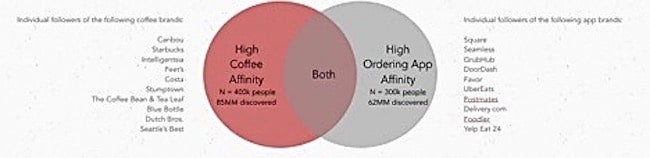
We could quantify that those people with high affinity for both dreamt in code. They are extreme tech geeks, and they care less about the coffee and more about the optimization of the coffee experience.
We stood by the actual Briggo Coffee robot for an afternoon and we could see the data come to life. The people who already had the app, and were buying from the airport Briggo were (regularly, without many exceptions) techies.
With this insight, we’re helping their UI team evolve the customer experience to be less centered on “great coffee” and far more focused on bringing a techie’s definition of “great coffee” to life: Good-tasting coffee exactly when they want it.
Left brain, too
We don’t have a fancy name for it, we just call it Digital Segmentation. None of this would be possible without the customer data. None of it. We could have never verified this tech-affinity through surveys or focus groups. But without our creative backgrounds, it would be impossible to translate that finding into adjustments for the customer experience and any other product or marketing initiatives.
When we start with customer data, we layer on interest & affinity data to tell us what customers are really into. And unlike most available analytics platforms that look at one platform (primarily Twitter), or are mention/keyword based, we’re looking at behaviors (engagement, follows, comments, mentions, shares) across the entire social net. It’s the left side of the modern marketing brain.
For any advertising that’s needed, media targeting is already baked, because our analysis was rooted in affinities for websites, influencers, and even YouTube channels). We need that left side of the brain, too.
When we were at agencies, we called this quest for customer truth “Shepherding.” It was meant to sell ad campaigns, or new products that resulted in ad campaigns.
What we’ve come to realize is that it can actually help clients NOT have to advertise as much. It can improve their products, and customer experience, and ultimately make them a lot more profitable. All of that feels good, and makes trading “the creative department” for staring at spreadsheets, well… worth it
Join the conversation