


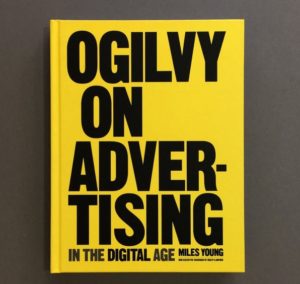
The following is an excerpt from Ogilvy on Advertising in the Digital Age (Goodman Books, 2018), an update to David Ogilvy’s classic Ogilvy on Advertising.
How then, to avoid the call of the dumpster?
It helps to have a sound definition; this is mine:
Content (noun): Communication so good you want to spend time with it or share it.
That’s a high bar. It means that something worthy of being called content must so capture you that you choose to watch, read or listen to it. It must spur you to vouch for its value as you repost it on to your friends.
When I was asked to write a sequel to David’s best book, I was very reluctant for many reasons, not least a strong sense of lèse-majesté. But a particular concern was that there were so many disconnects with his world that it would be very difficult to make any ties.
But the more I thought about it, the more it seemed to me that this world may have been turned upside-down, but it was still essentially the same; that the language and the technology may have changed, but that many of the principles had not. After all, wasn’t it David Ogilvy who reminded us that “the consumer is not a moron, she is your wife?” In fact, when we have really wanted a client to understand what content is, I showed a video clip of David from the early 1980s, talking to camera.
“It seems to me that print editors must know how to communicate [better] than we admen,” he says. “We admen have an unconscious belief that an ad has to look like an ad. Ad layouts signal to the reader: ‘This is only an ad, skip it.’ So, always pretend you are an editor.”
This is the mindset that is required for content online. You need journalists, people who understand how to engage content beyond the confines of a 30-second TV spot, not just in length but also in depth. Journalists expand investigation into a subject; the traditional creative team compresses it. These are two very different things.
You will need people with curatorial skills: collating, re-presenting, showcasing, and acknowledging the source of material we did not originate ourselves—and doing it with pride. These skills are not common. They require subject matter speciality, even scholarship, combined with a generalist bent, as well as a broad network of other curators and experts to call on.
Curators are, in the ponderous words of the American Alliance of Museums, “information brokers, who, through learned and creative interpretation, create meaningful experiences for people.”
All this betokens a shift in the business of agencies, which is still not recognised or even expected—namely, they are becoming publishers. It is content that we will produce in the future, not advertising, direct-mail pieces, or whatever. As such, agencies will—or should—cease behaving like agents (who used to get paid by the media in a system invented in the mid-18th century) and act more like the media itself. We have, if we want it, the chance to break the shackles of our past. And brand owners also need to think of themselves as publishers.
While the industry has been tardy at aligning behind a clear definition of content, it is also extraordinary that it has been for a long time a planning-free zone.
Like all such constructs, these quadrants are not hard and fast. There are overlaps and grey areas. Information, for instance, can be highly entertaining; and many great pieces of content have provided it in documentary formats that entertain.
Nonetheless, teasing out differences helps give a more thoughtful approach to this amorphous thing, content. But the differences are all more or less, rather than either/or. Another helpful way of using this content matrix is to see it as a playground in which two great dividends can be looked for: creating experiences and creating engagement.
The digital world has put a premium on design: experimental design has become a critical pillar of the digital world. Enjoyment, however, comes through the power of stories. Neither designing experiences nor narrative enjoyment are remotely new concepts, but in the digital world they have both exploded in importance. They bring the “content” to content.
And that rich content helps define a whole stance to communicate, which is built around quality. At the end of the day, the best data is opt-in data. And rich content fuelled by quality data is a paradigm which Vance Packard’s The Hidden Persuaders could not have envisioned. With it, we have ceased to be hidden. You can use us or lose us. We are the open persuaders.
Join the conversation